I’m Diana Radchenko, a high school student interested in computer science. These projects show the questions I ask, the decisions I make, and how I test my ideas.
Interactive physics · Connected career tools · Algorithmic accountability
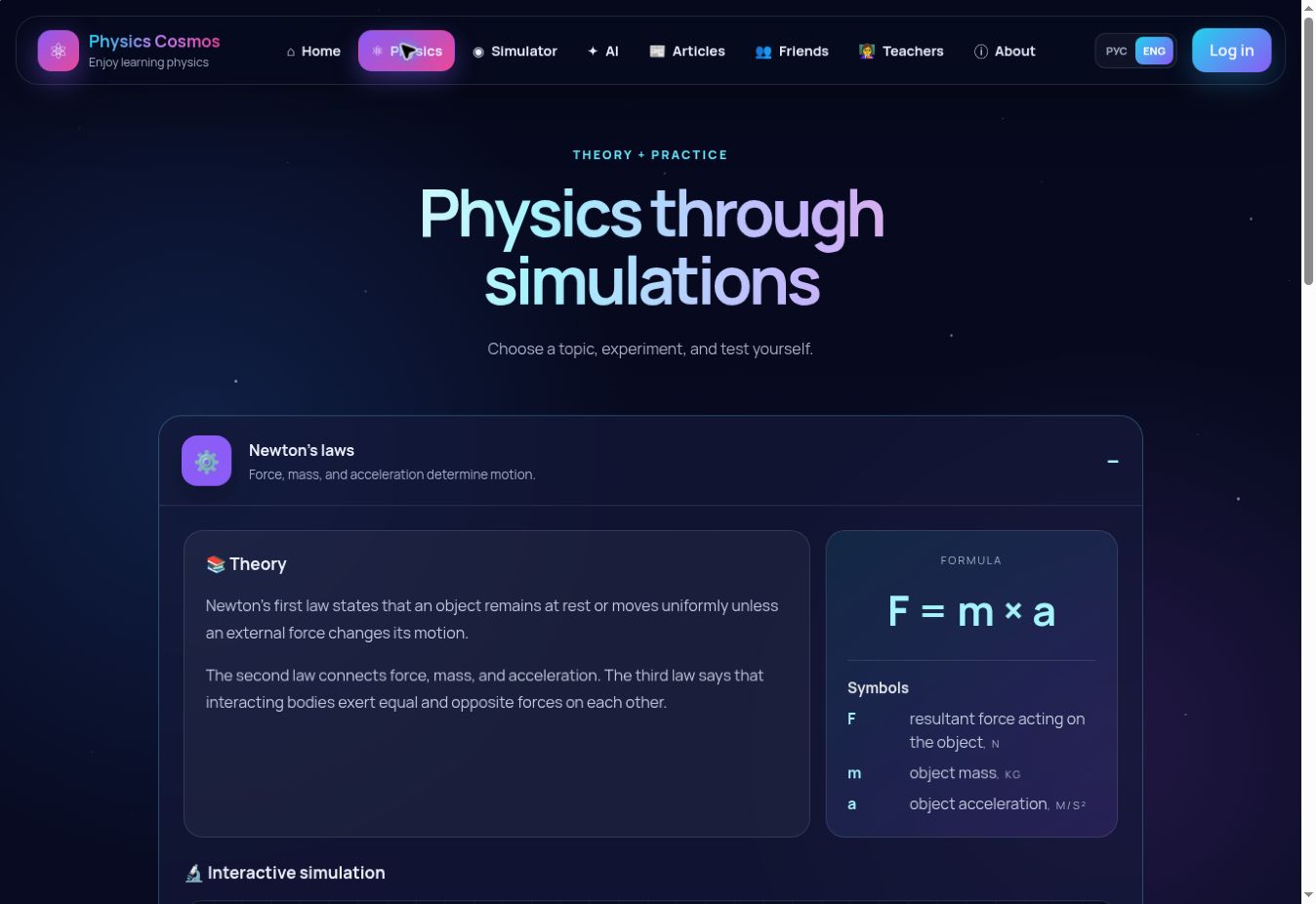
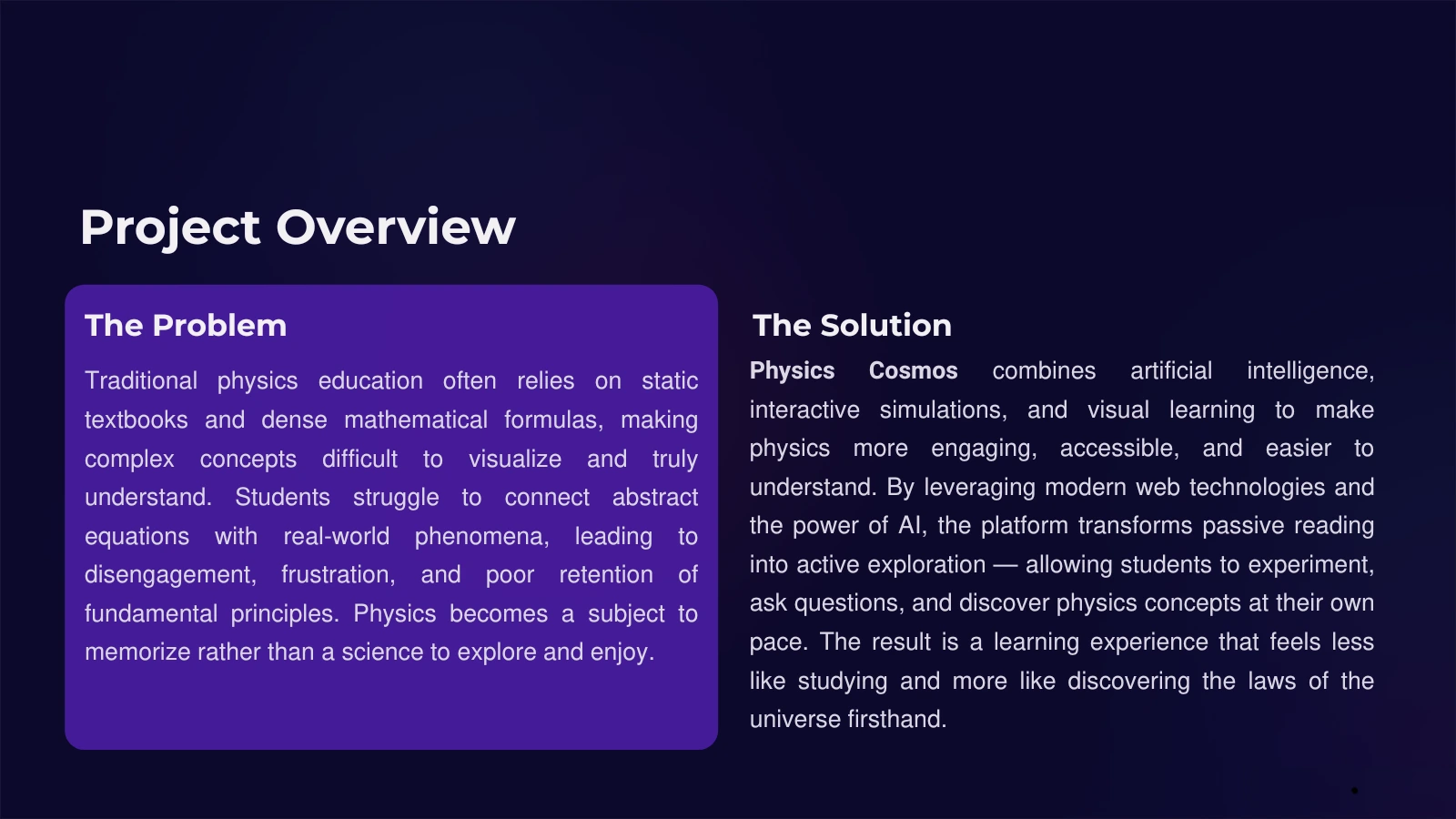
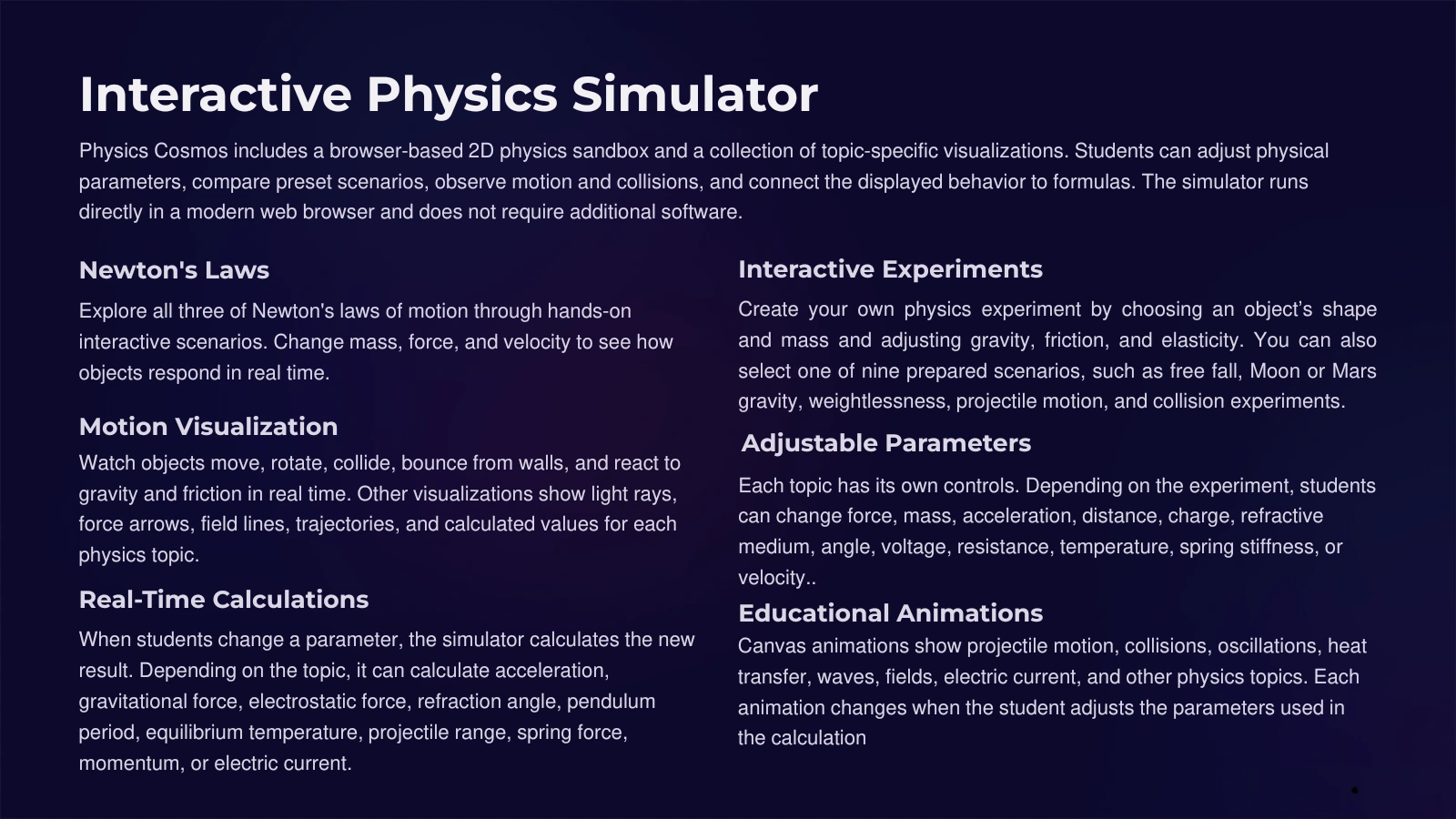
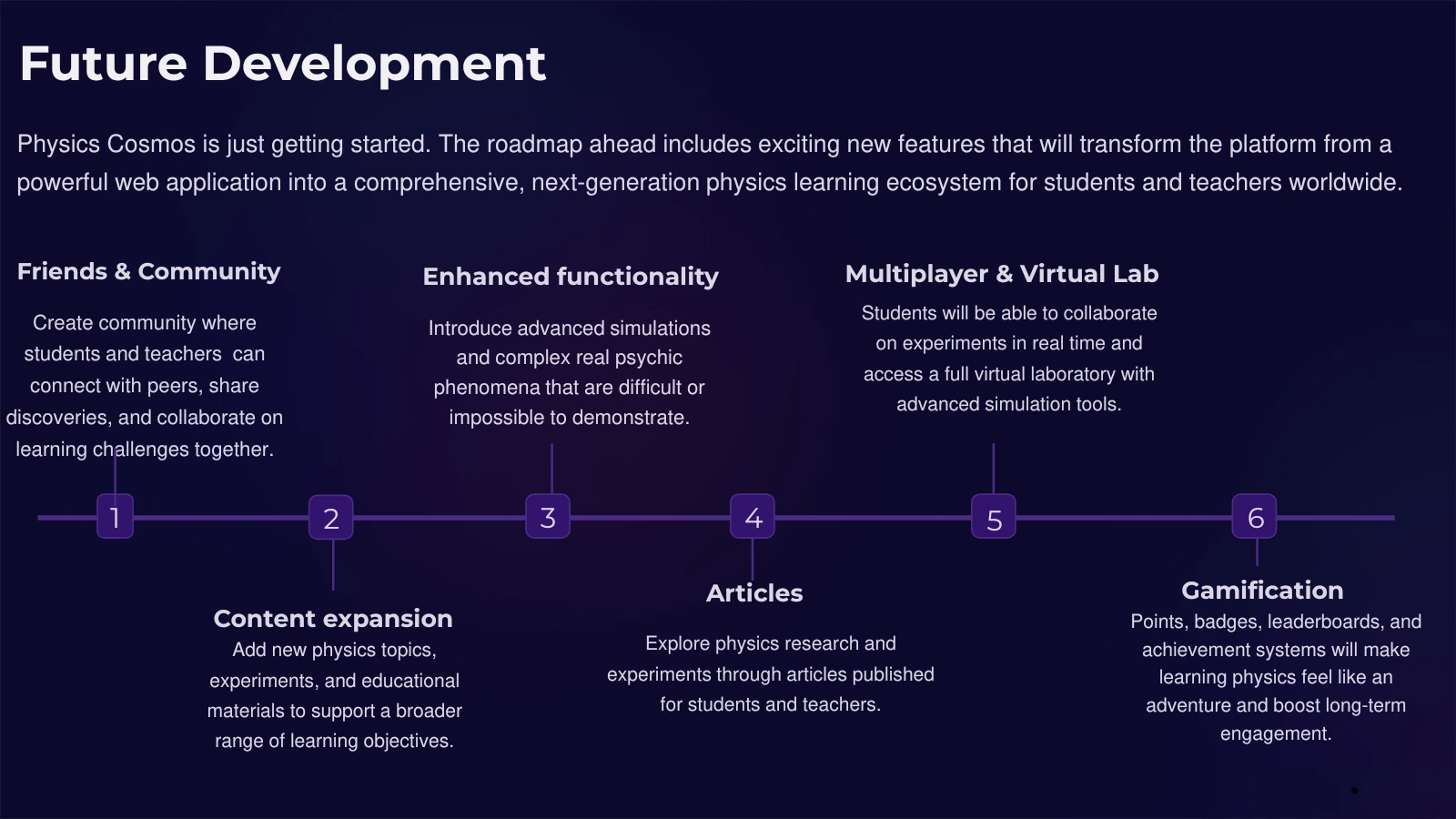
Physics can be hard to picture from formulas alone. In Physics Cosmos, a student changes a value, such as mass, force, or angle, and sees the calculation and animation respond together. The equation, controls, and picture have to agree.
What it includes
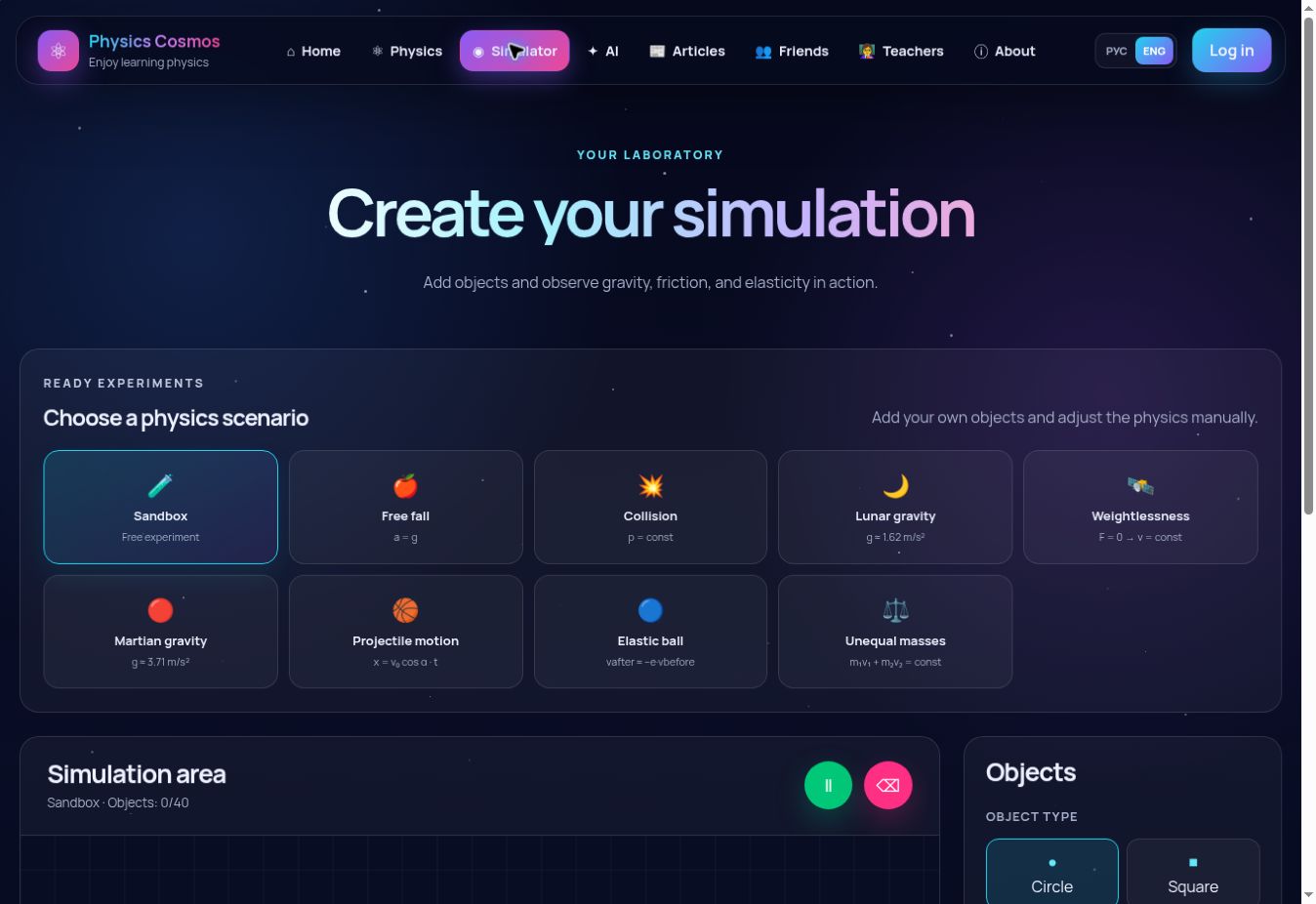
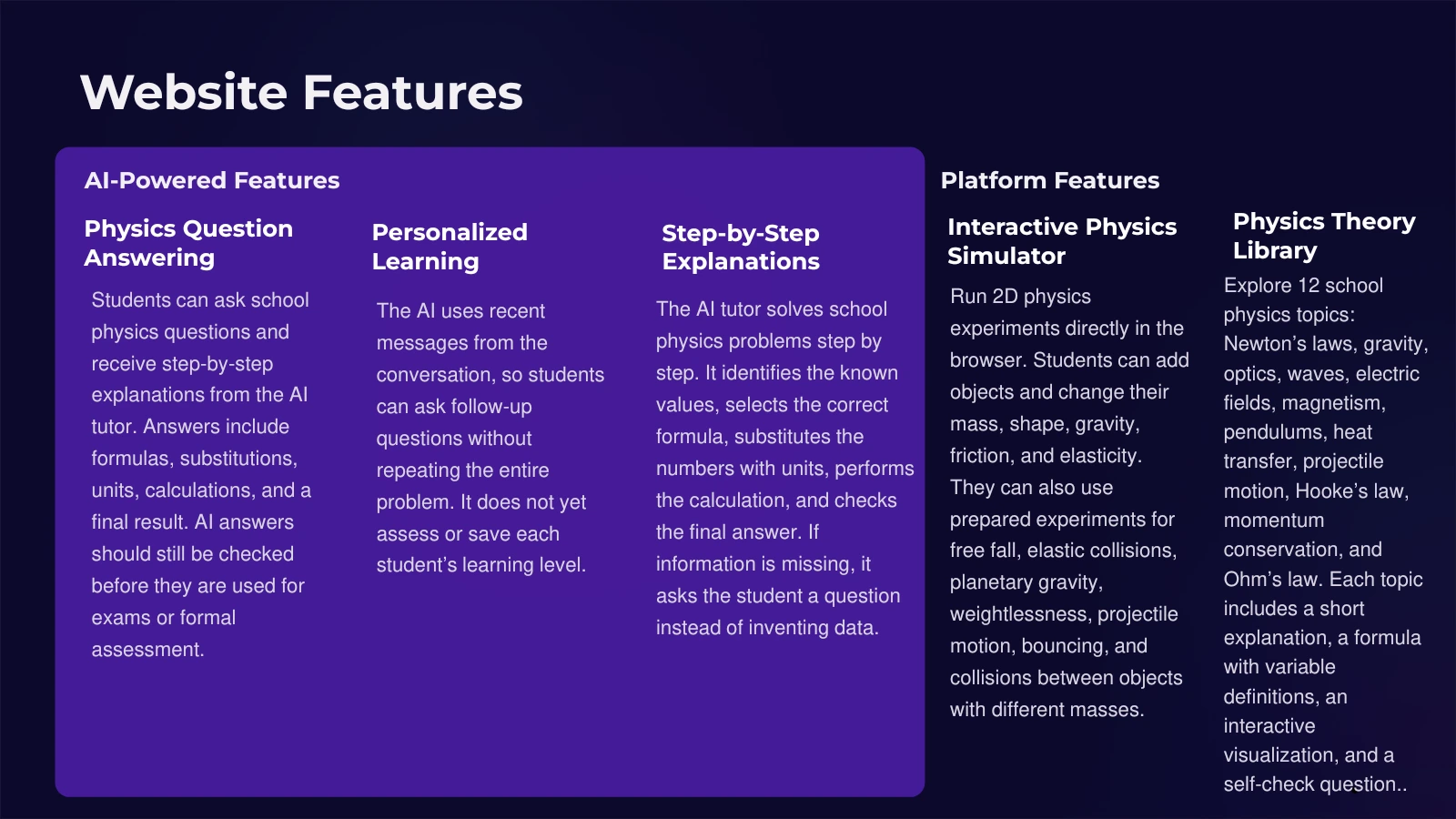
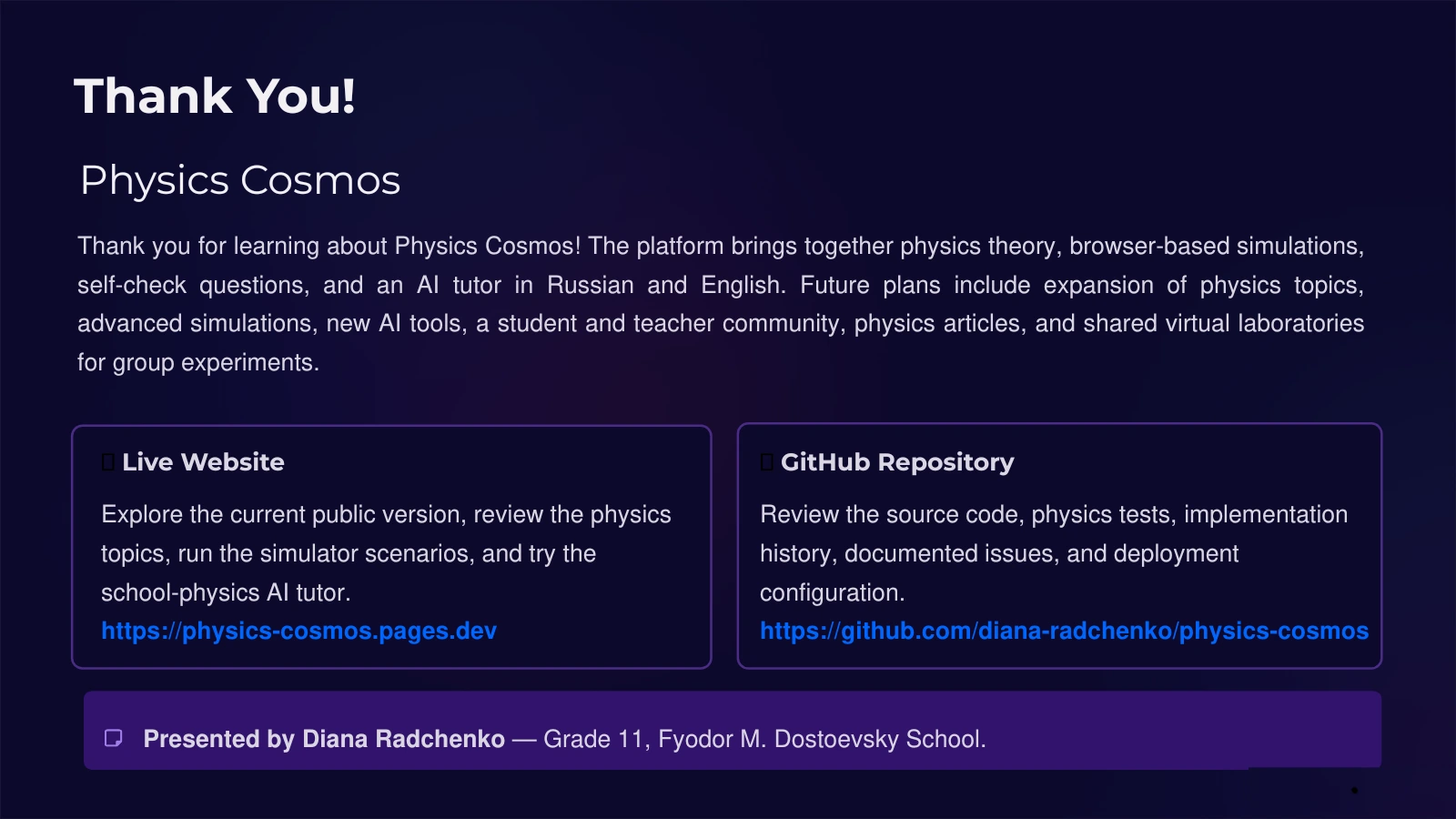
Twelve physics topics, eight prepared experiments plus a sandbox, and an AI tutor in English and Russian.
More ways to explore
Friends / Student chat
A contact list and conversation interface for adding classmates and discussing physics problems.
Teachers
A separate contact and chat interface for adding teachers and discussing schoolwork.
Articles
Physics materials, project news, and recommendations for students and teachers, with a draft editor and AI-assisted formatting workflow.
About
My introduction to the project: why I started it, its learning goals, and the values behind its design.
Contacts, conversations, and article data currently stay in the user’s browser. These interfaces are not a shared, real-time community service.
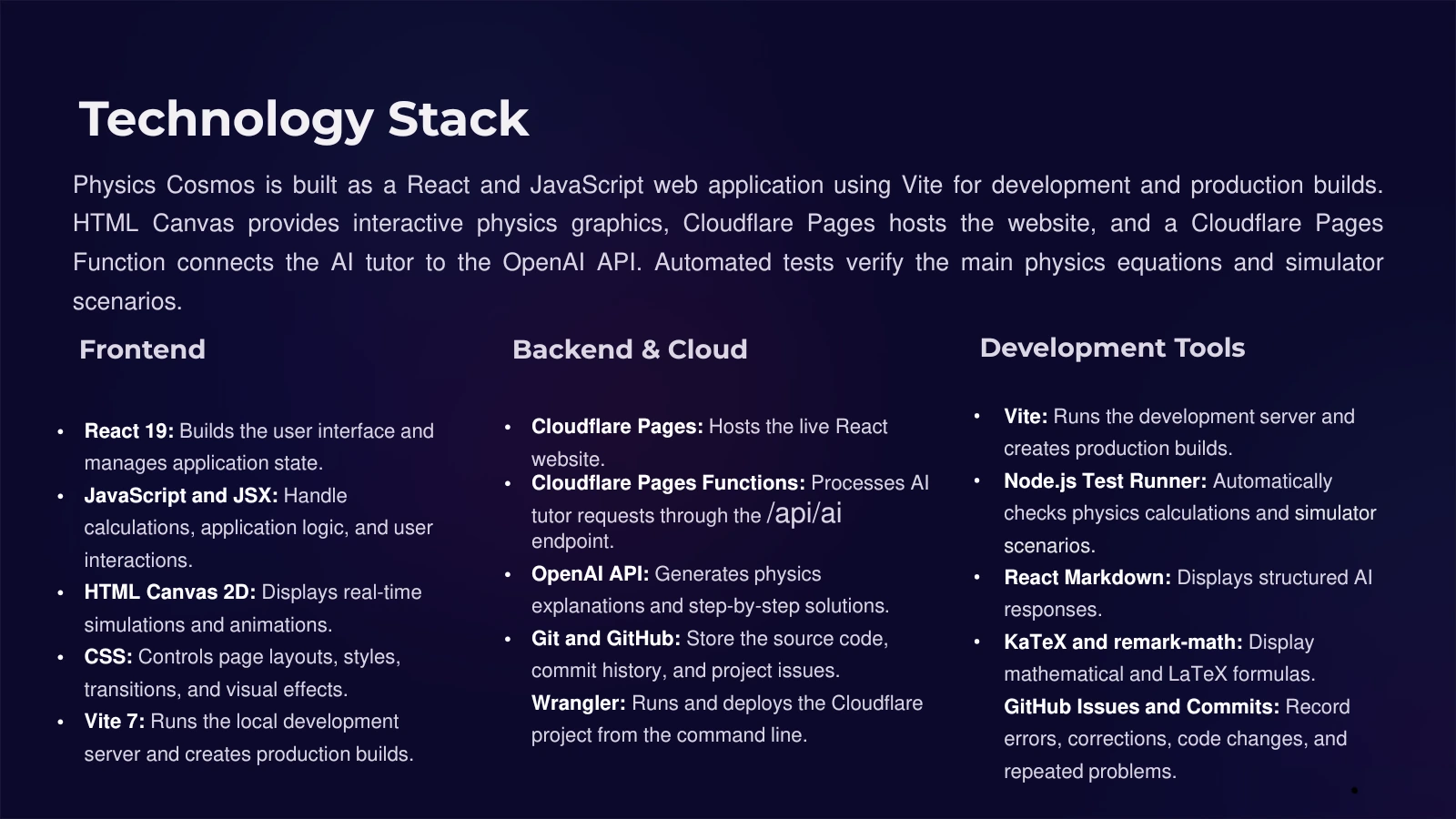
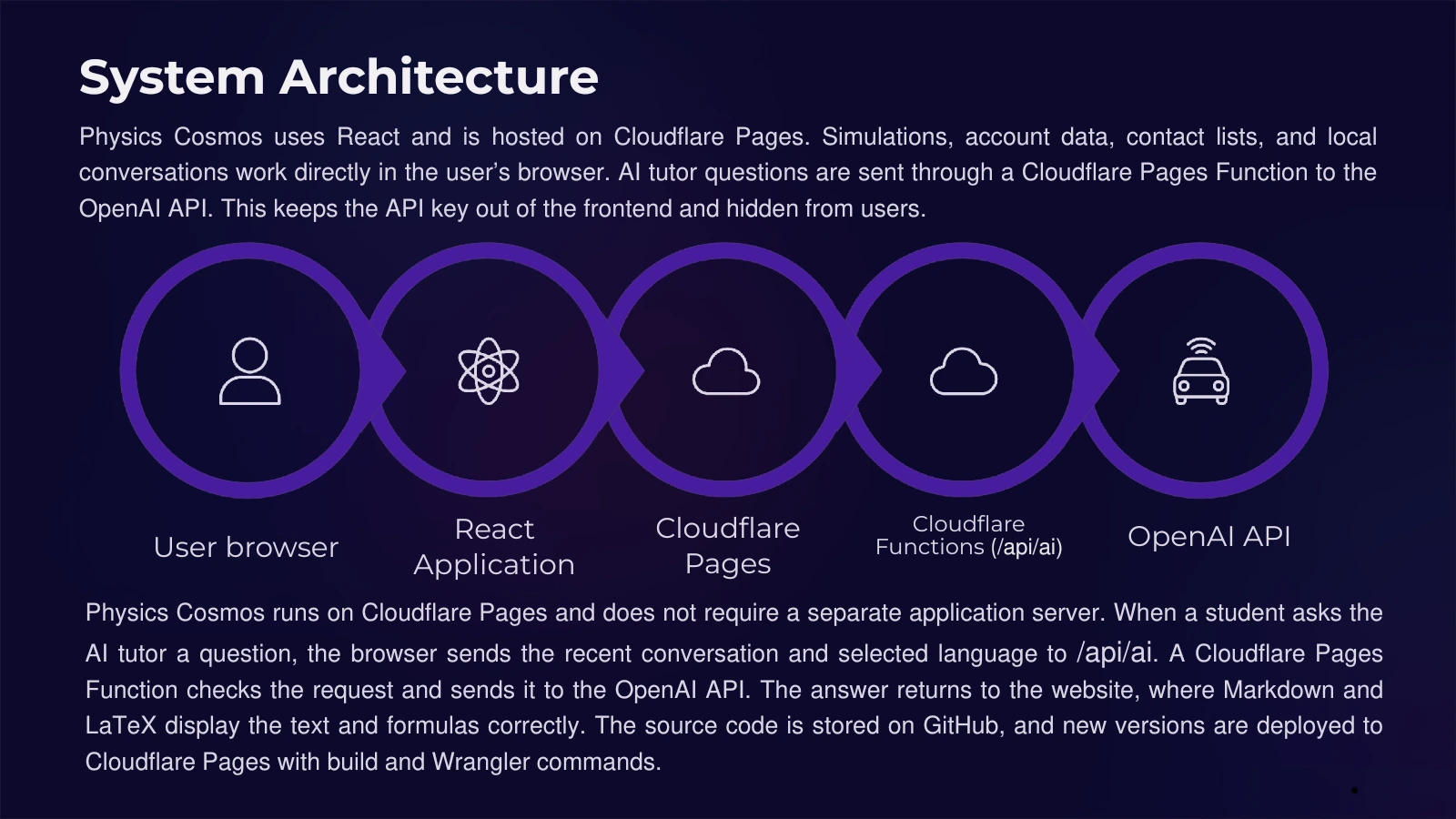
React · JavaScript · Vite · HTML Canvas 2D · Cloudflare Pages & Functions · OpenAI API
My contribution
I planned the navigation, page structure, and learning content, and decided what each topic and experiment should let students explore. I developed the project outside school, mainly at home after classes and on weekends.
I worked with AI coding tools, specifying tasks, checking the physics, testing, integrating changes, and deciding what was finished. During the summer, I refined Newton’s Laws and optics, improved mathematical rendering in AI answers, and expanded self-check exercises.
My informatics teacher advised me on the interface and presentation.
Presented in the in-person final round of “Engineers of the Future,” MPEI, April 22–25, 2026.
The challenge
The controls must obey the equation
In the Newton’s Laws calculator, changing force, mass, and acceleration independently could produce contradictory values. I refined the calculation modes so the selected unknown is calculated from the other two quantities.
This made consistency a practical test: the controls, calculated values, and visualization had to agree. I also checked physics calculations and simulator scenarios, including optics, and reviewed the way formulas appear in AI answers.
Eight prepared experiments plus a sandbox — nine selectable scenarios in total.Current scope
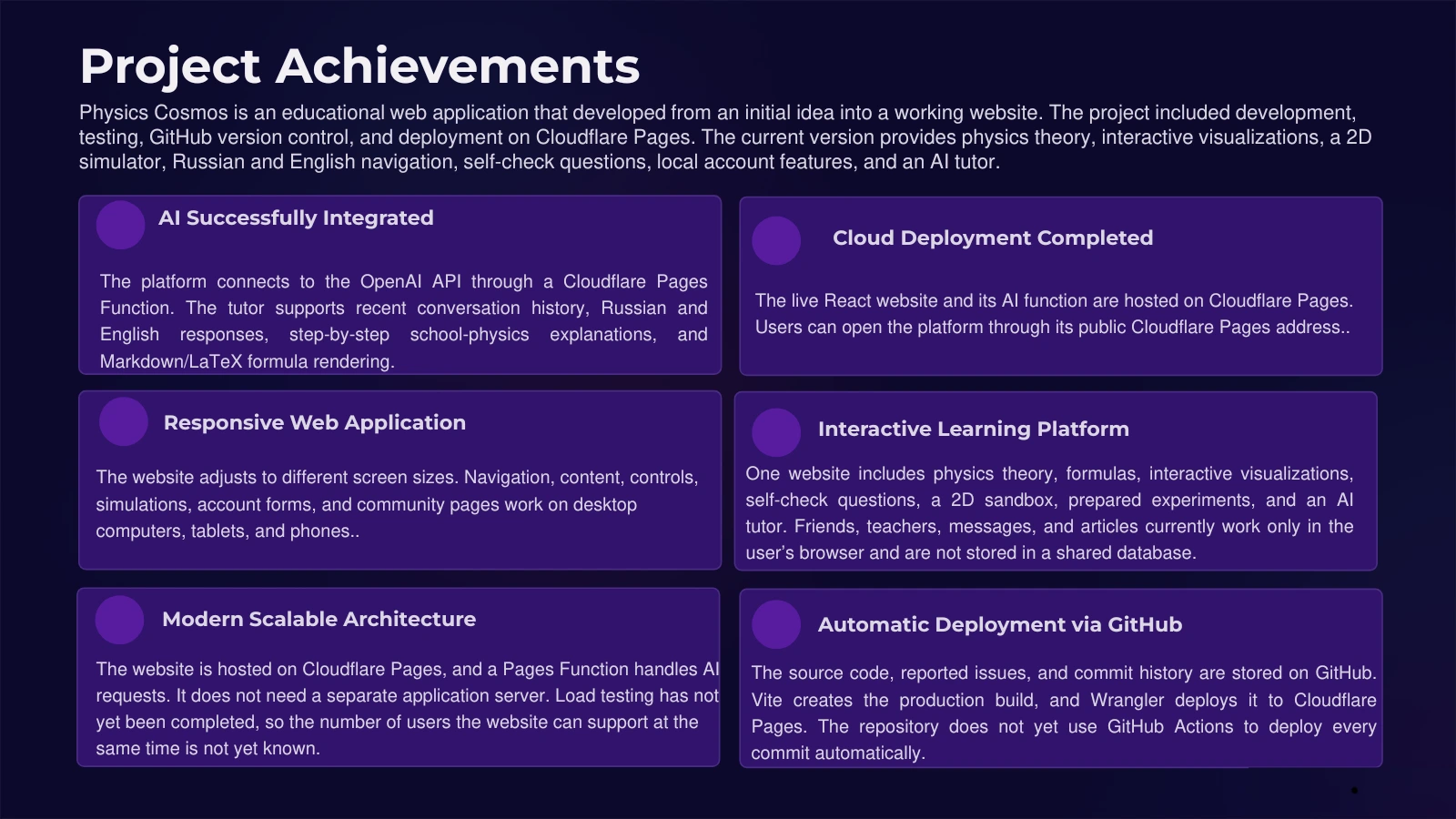
Learning outcomes have not been measured. Community features use browser-local data. The AI tutor uses recent conversation context rather than tracking a student’s learning level, and its answers still need checking.
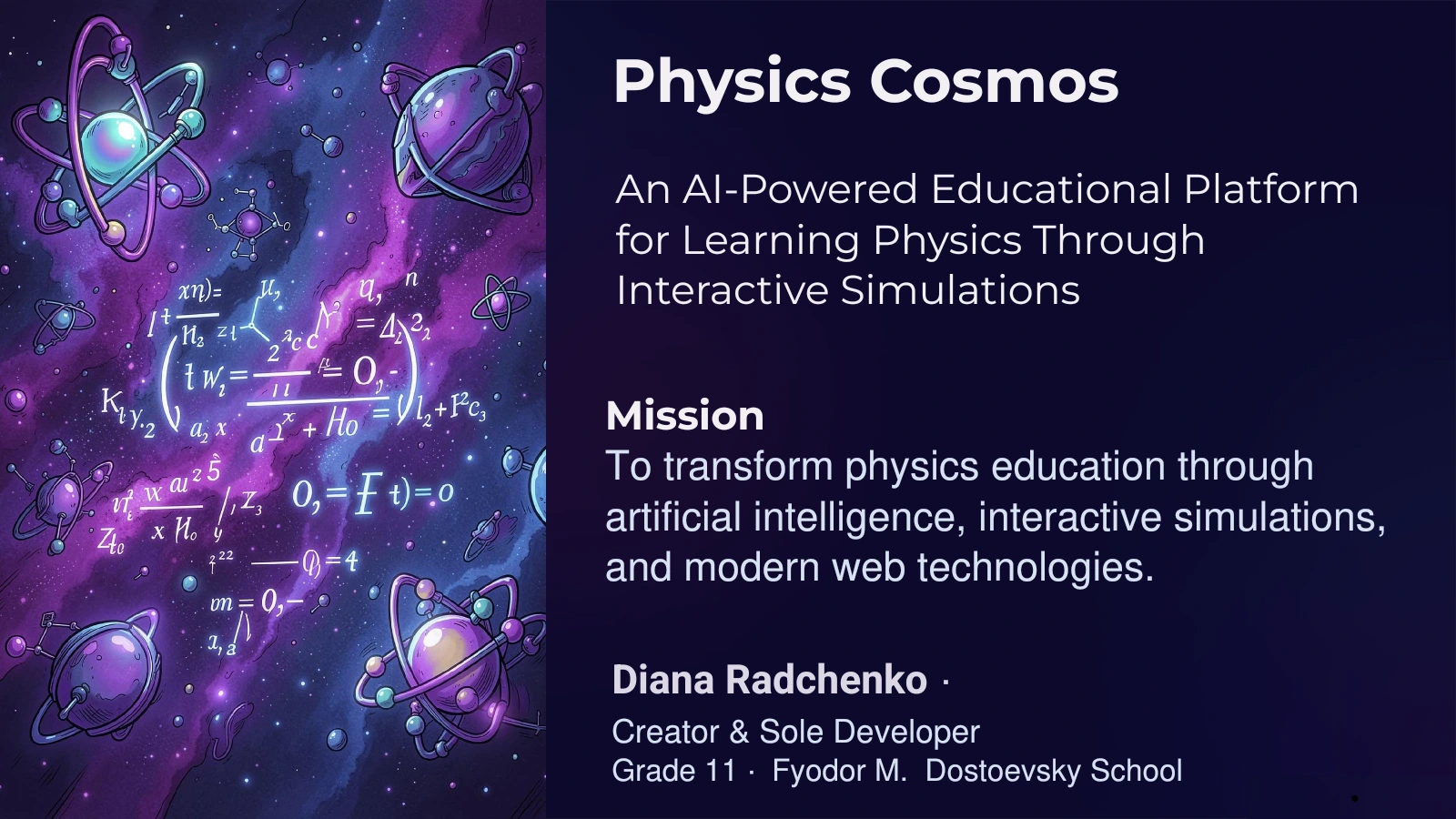
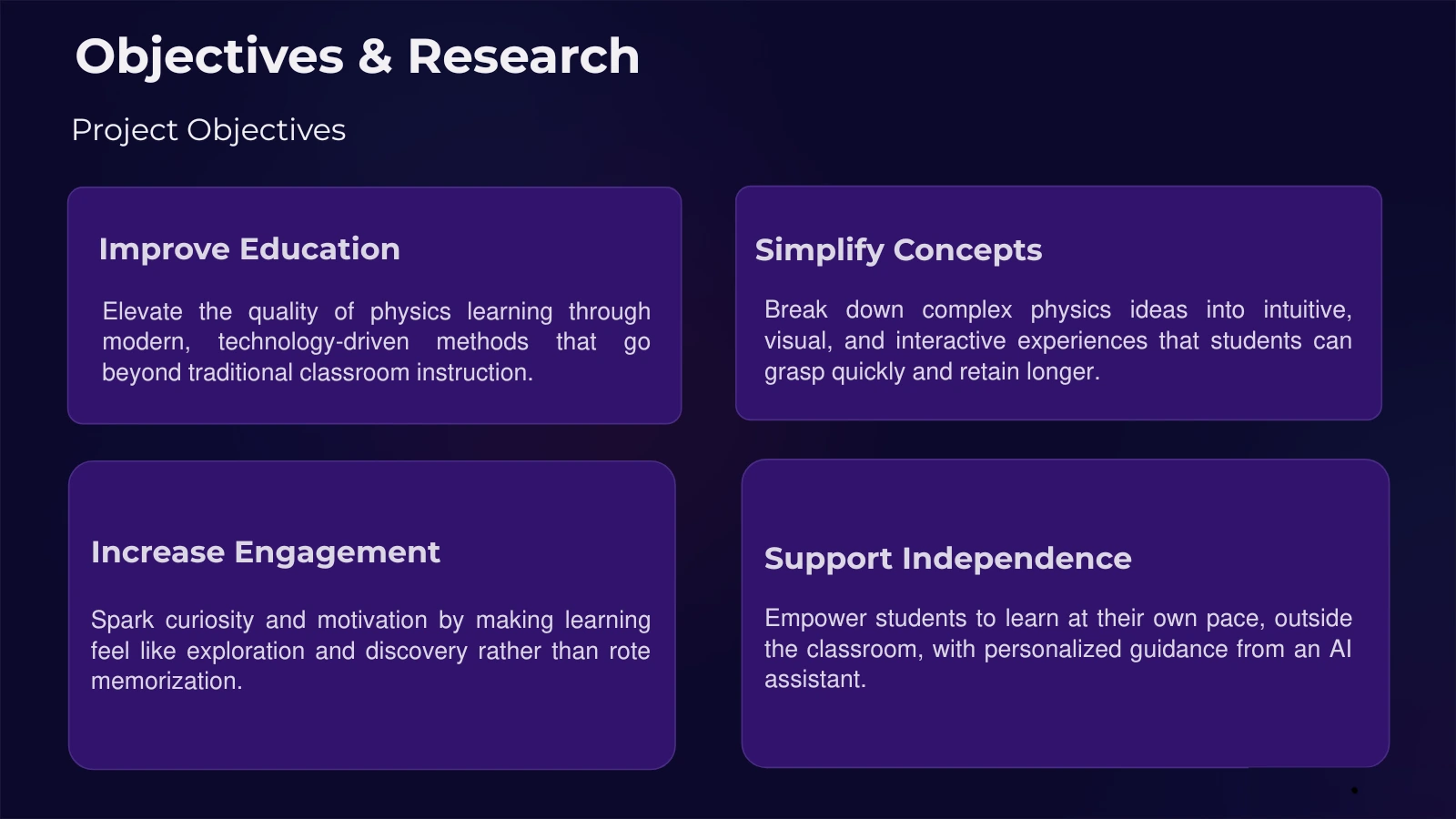
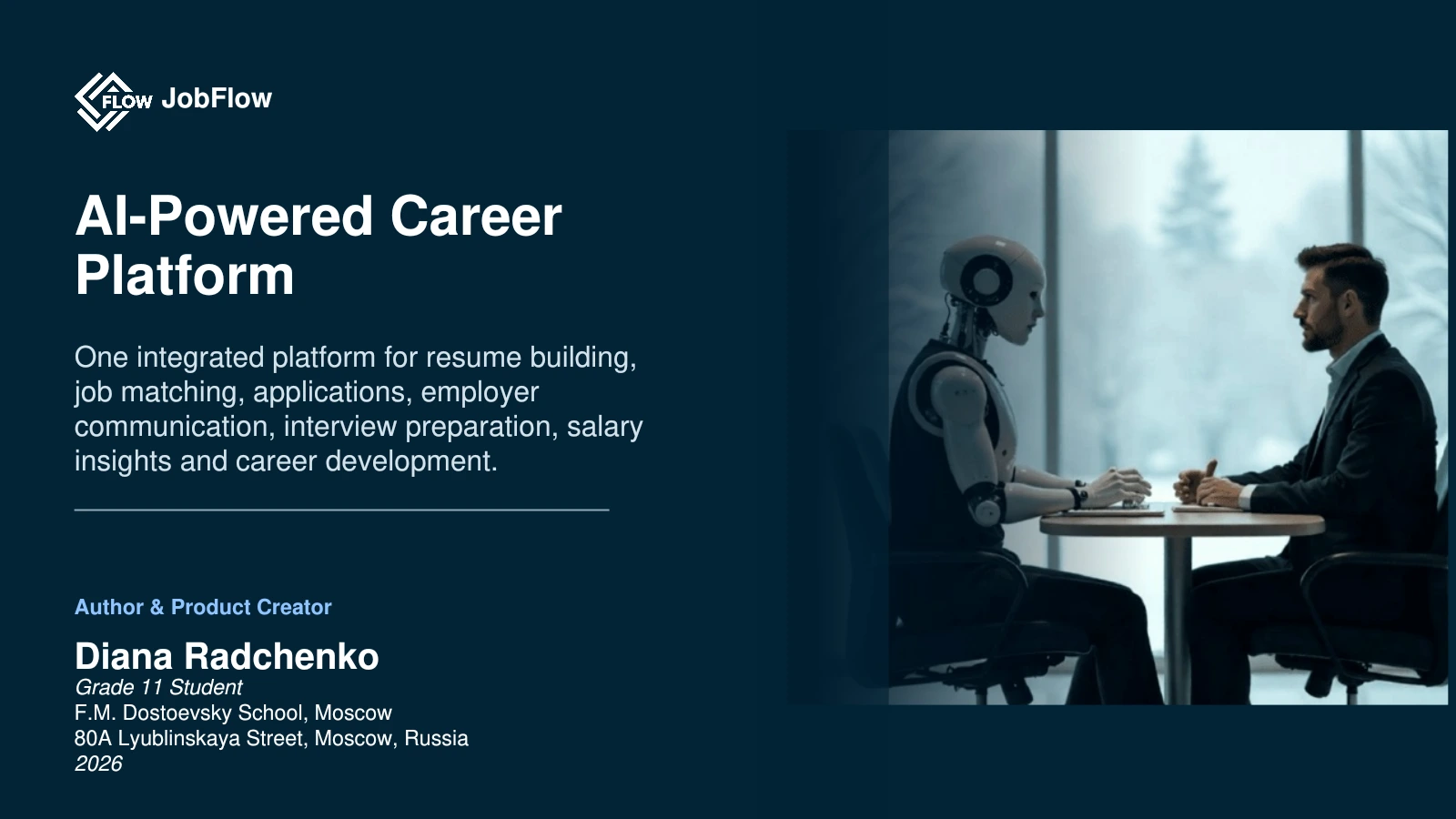
Original presentation slides. Open a slide to enlarge it.
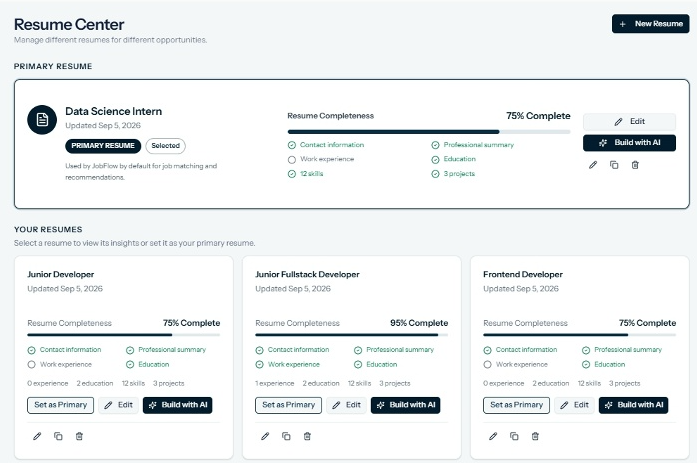
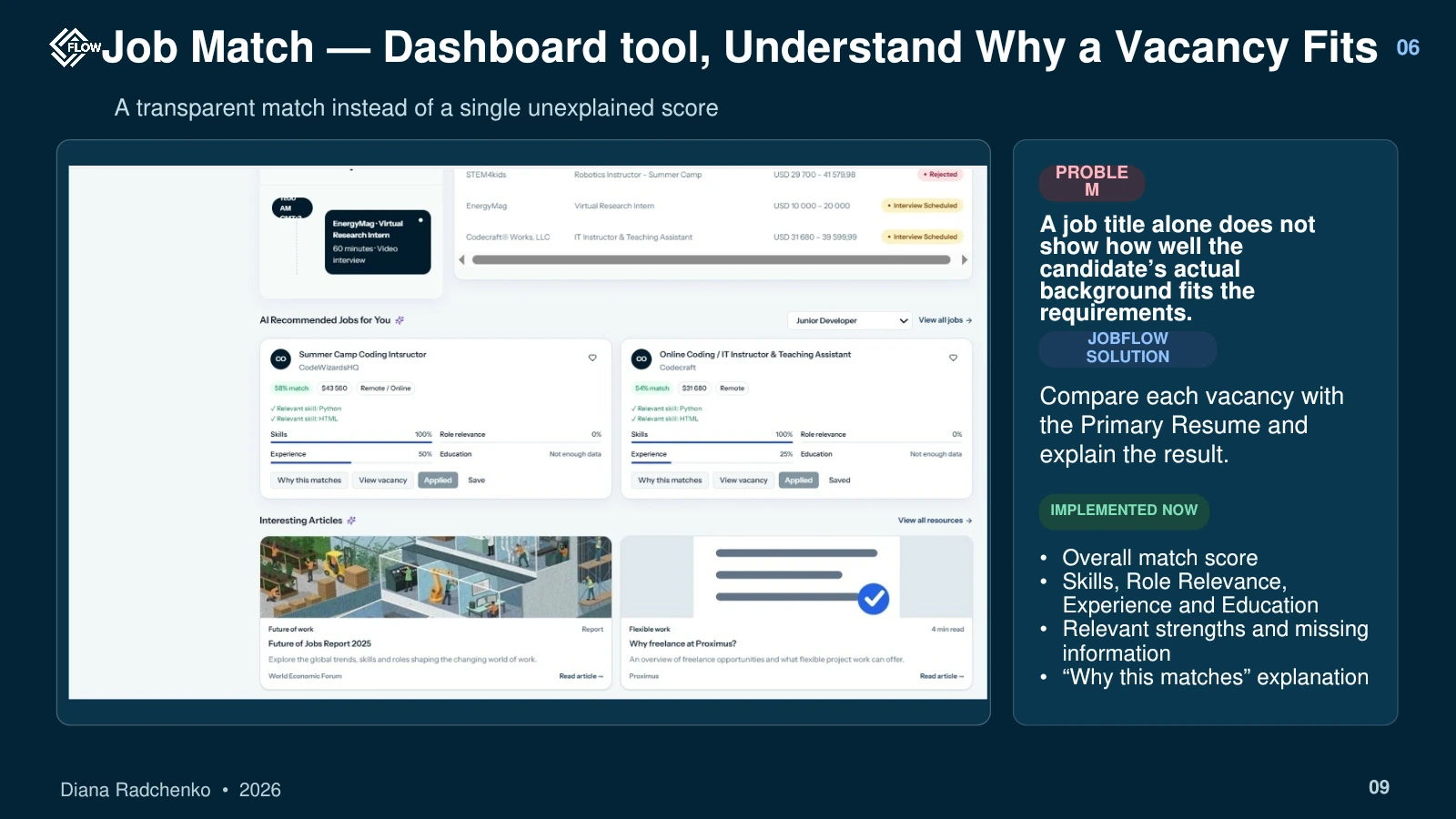
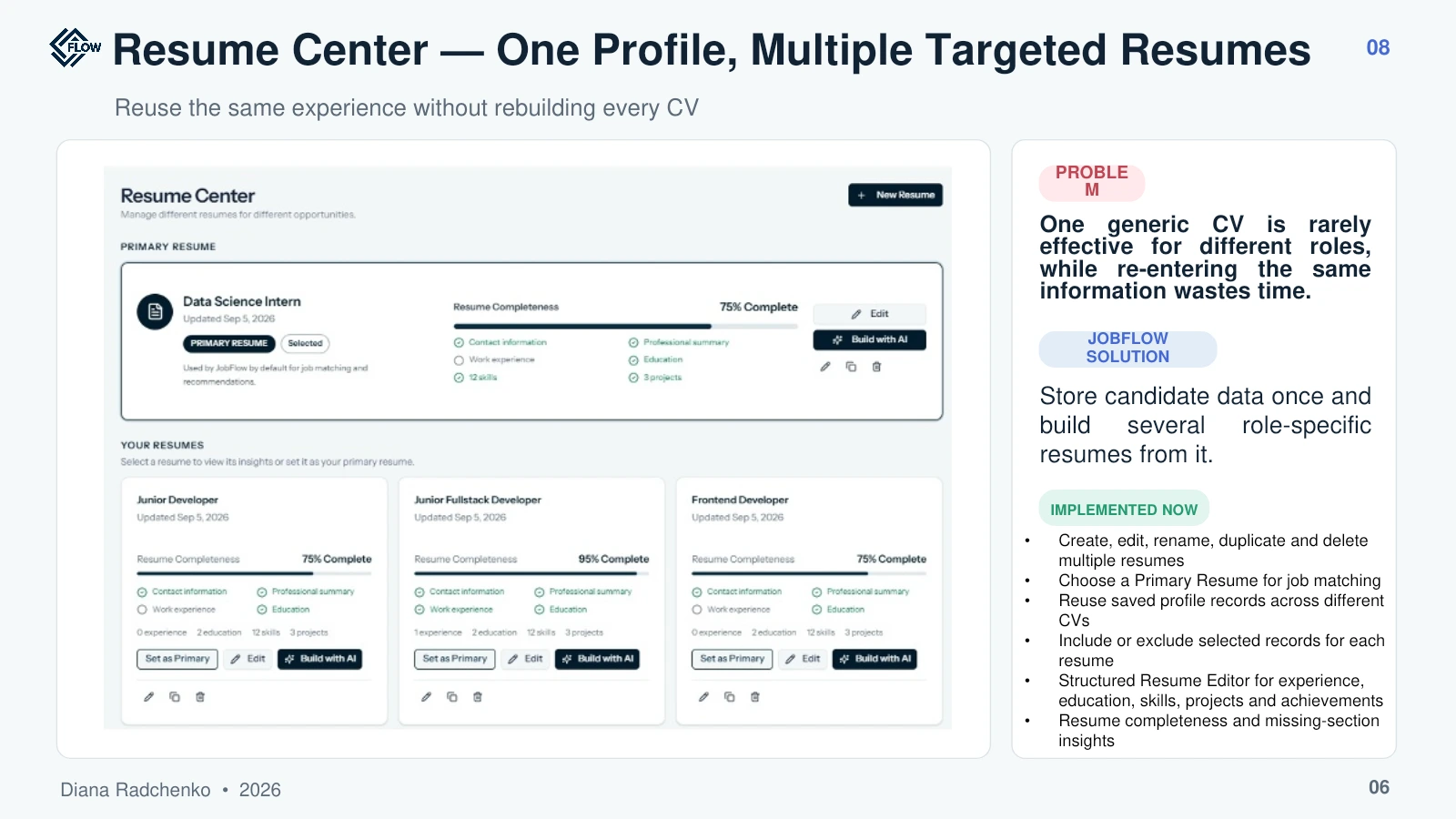
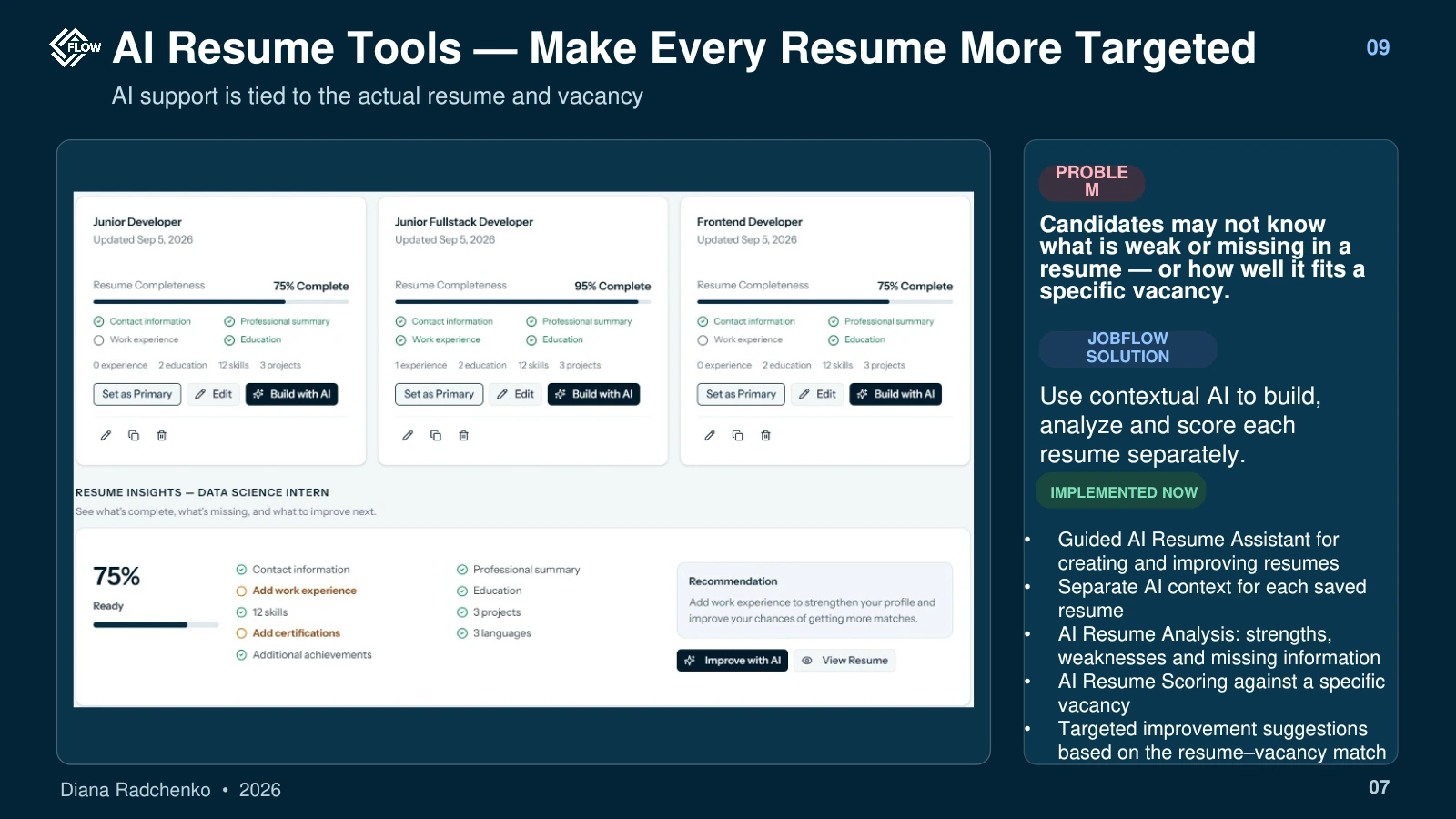
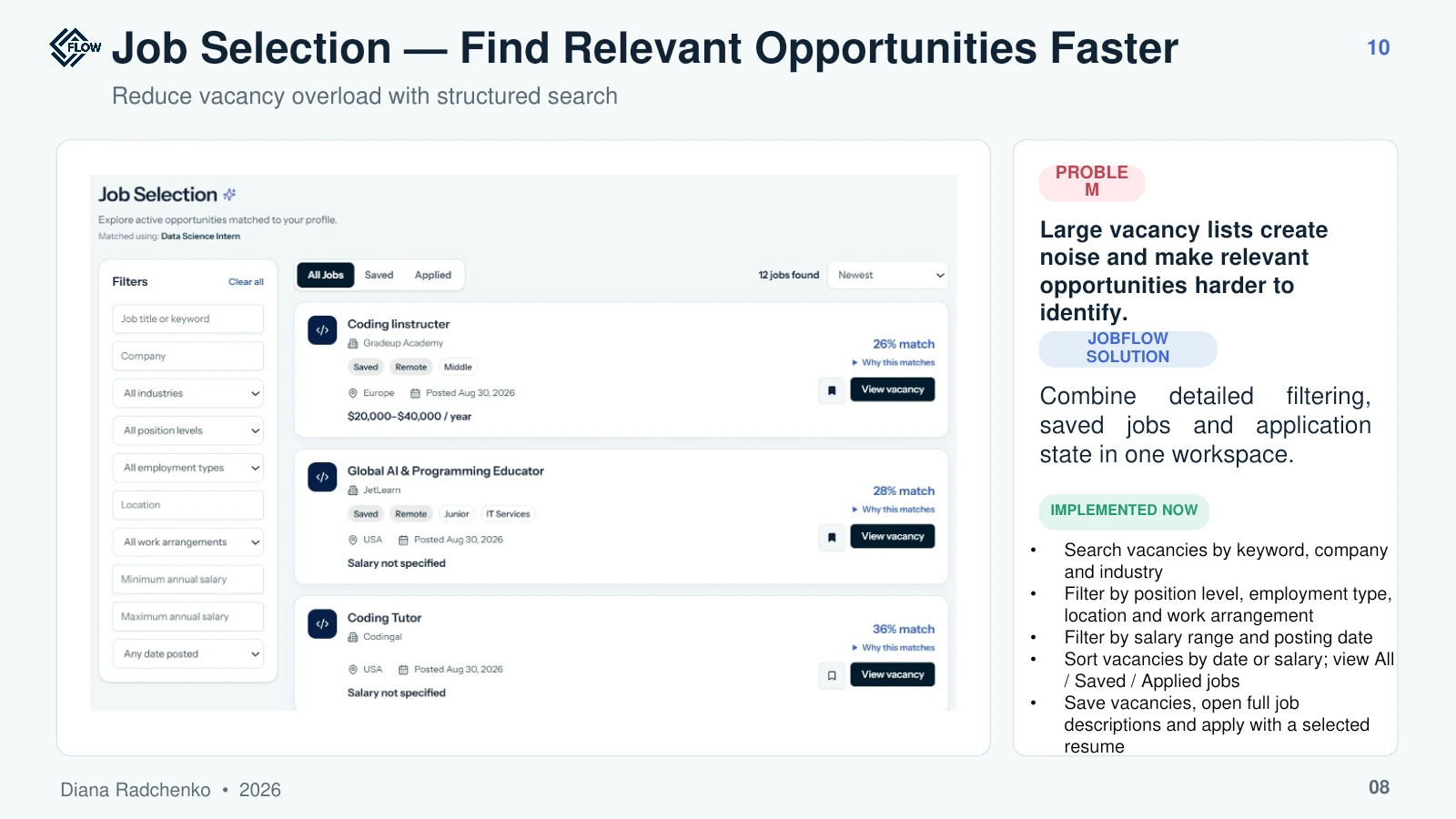
JobFlow: open Resume Center, inspect the Primary Resume, then explore Job Selection and “Why this matches.”
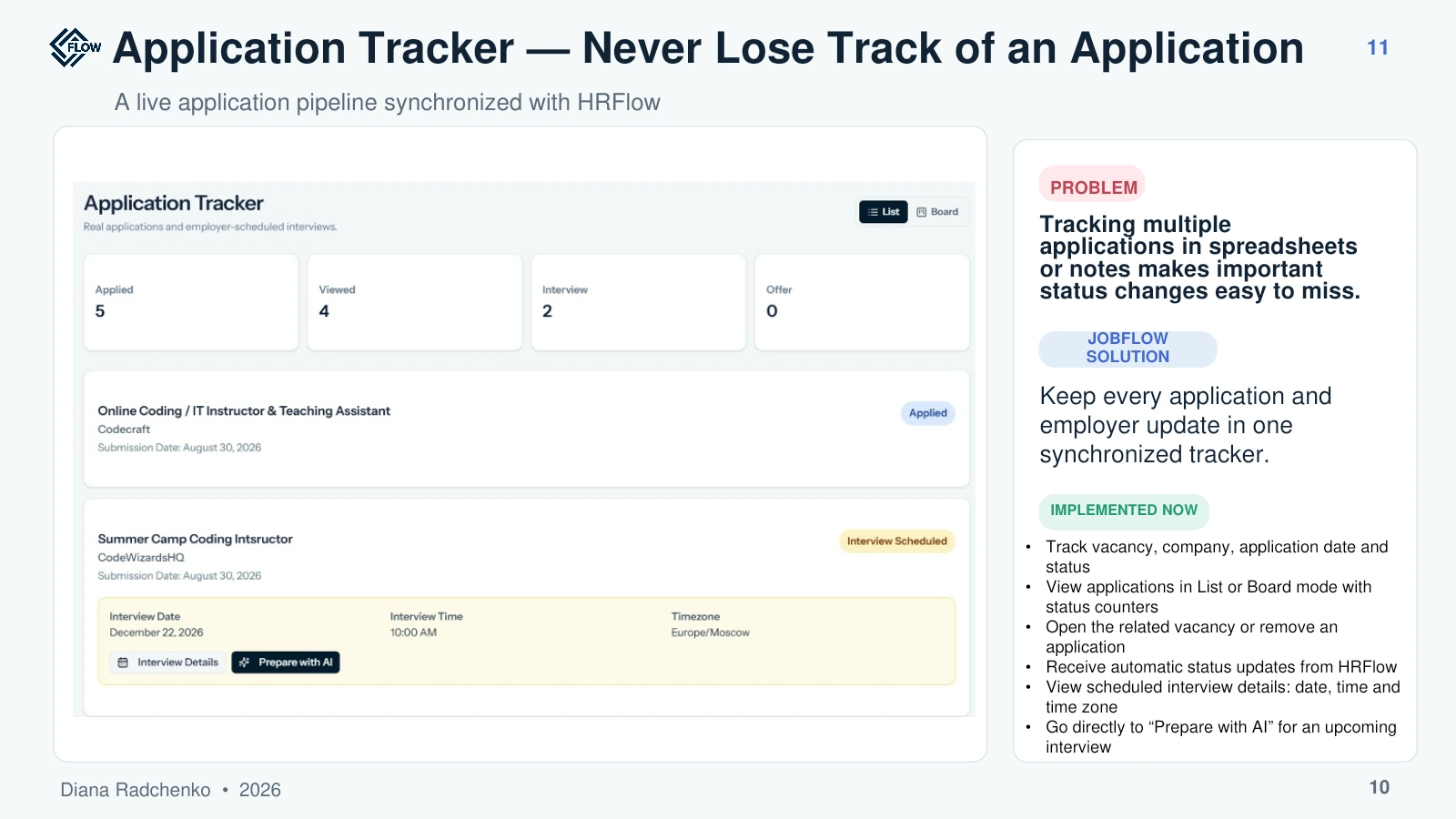
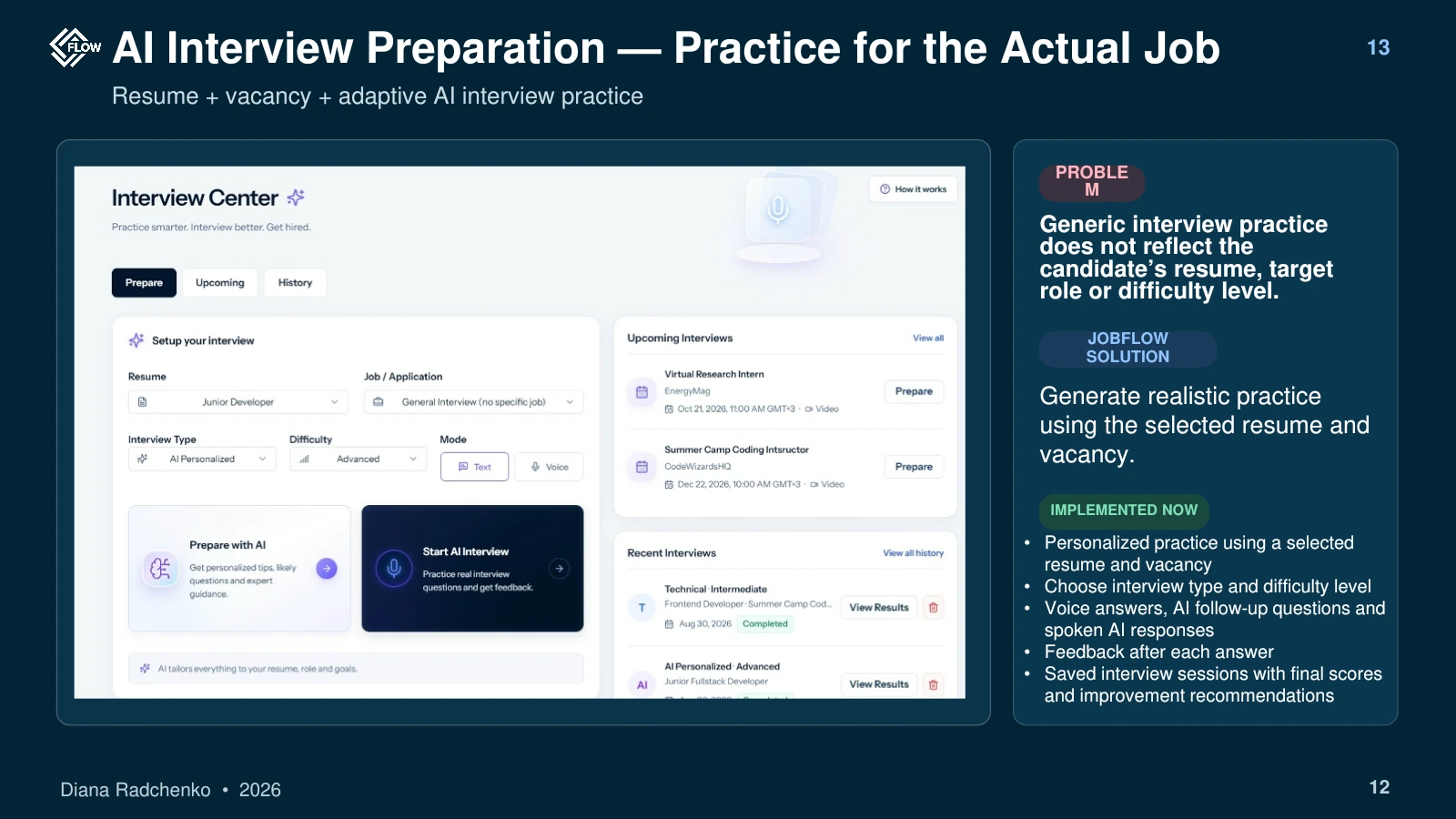
Follow the workflow: inspect the Application Tracker and Interview Center.
HRFlow: inspect vacancies and their applications to see the employer side.
Shared test accounts: use example data only. To switch roles, sign out of the current FLOW account first.
FLOW / Actual interface
The Primary Resume provides context for Job Match.
Where it started
FLOW began with a dinner-table conversation: my mother, who works in HR, described how recruiting is split across tools that do not share information.
The idea
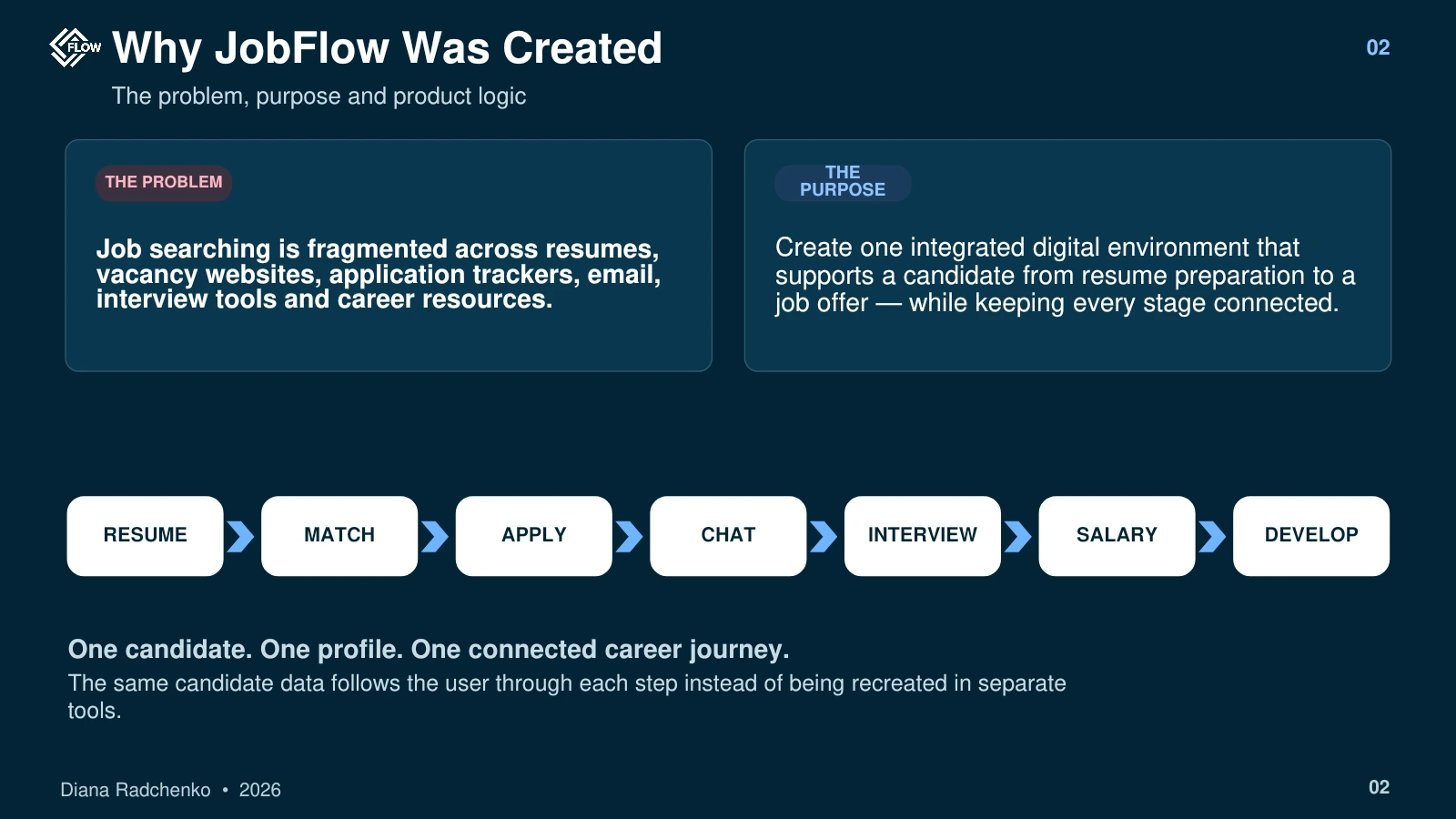
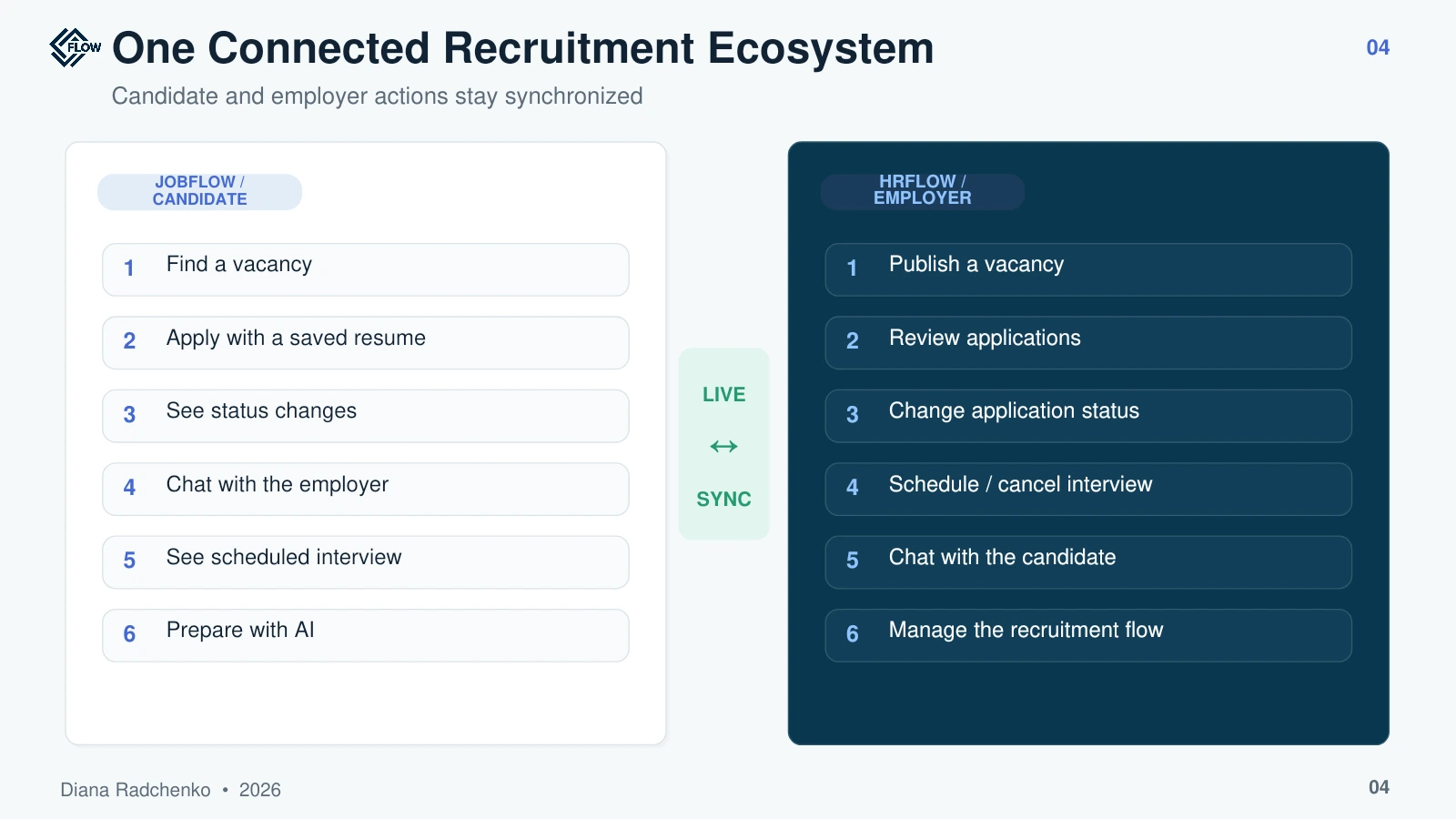
I designed a connected platform: JobFlow for candidates and HRFlow for employers, sharing vacancies, applications, statuses, and messages. One feature I worked on closely is Job Match, a score that explains itself.
I created the concept, requirements, user journeys, and development plan. A collaborating developer implemented a significant part of the initial technical version from those requirements. I later worked directly in the codebase.
I rebuilt Job Selection, including filters, sorting, and Saved and Applied views; substantially improved Job Match; improved resume workflows and AI tools; and connected candidate and employer actions.
I tested complete recruitment journeys, worked with regression tests, used GitHub branches and pull requests, and checked that deployed code matched GitHub. I used AI coding tools and reviewed changes in the working application.
My mother explained HR practice; I translated that advice into product requirements and decisions.
The challenge / Job Match
Explain the score. Recognize student experience.
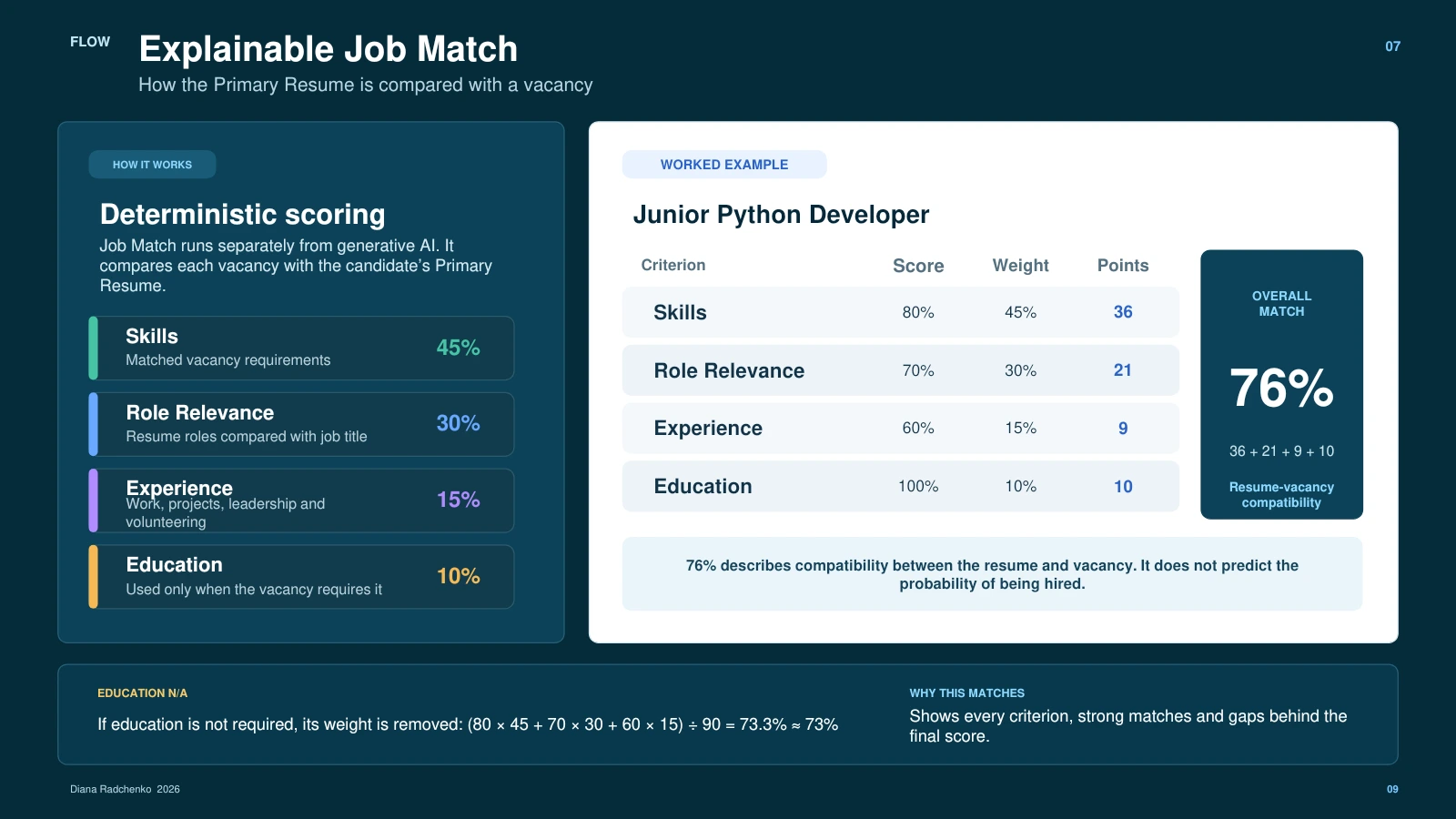
I refined matching rules so projects, leadership, and volunteering could count alongside employment. “Why this matches” shows the separate criteria behind the percentage.
45%Skills
30%Role relevance
15%Experience
10%Education
Education is excluded when a vacancy does not require it; the remaining weights are normalized. This deterministic algorithm is separate from generative AI and measures compatibility rather than hiring probability.
Connecting both sides of recruitment
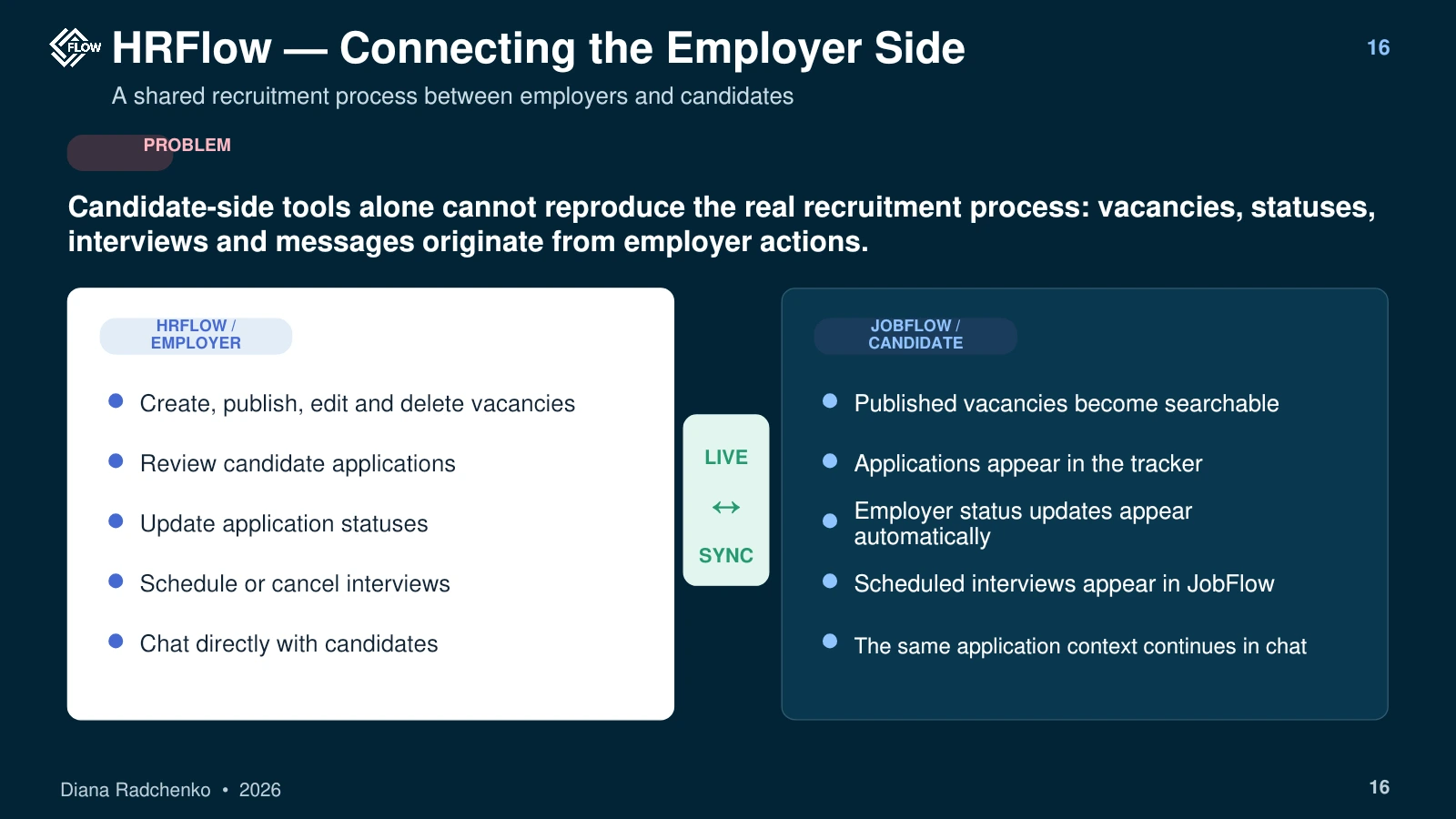
The candidate’s journey depends on what the employer does next. I worked on connecting JobFlow and HRFlow around the same vacancies, applications, statuses, interviews, and messages.
When an employer publishes a vacancy, a candidate can find it and apply with a selected resume. The employer can review the application, update its status, schedule an interview, and continue the conversation. I improved these connected workflows and tested the full path from both sides.
Current scope
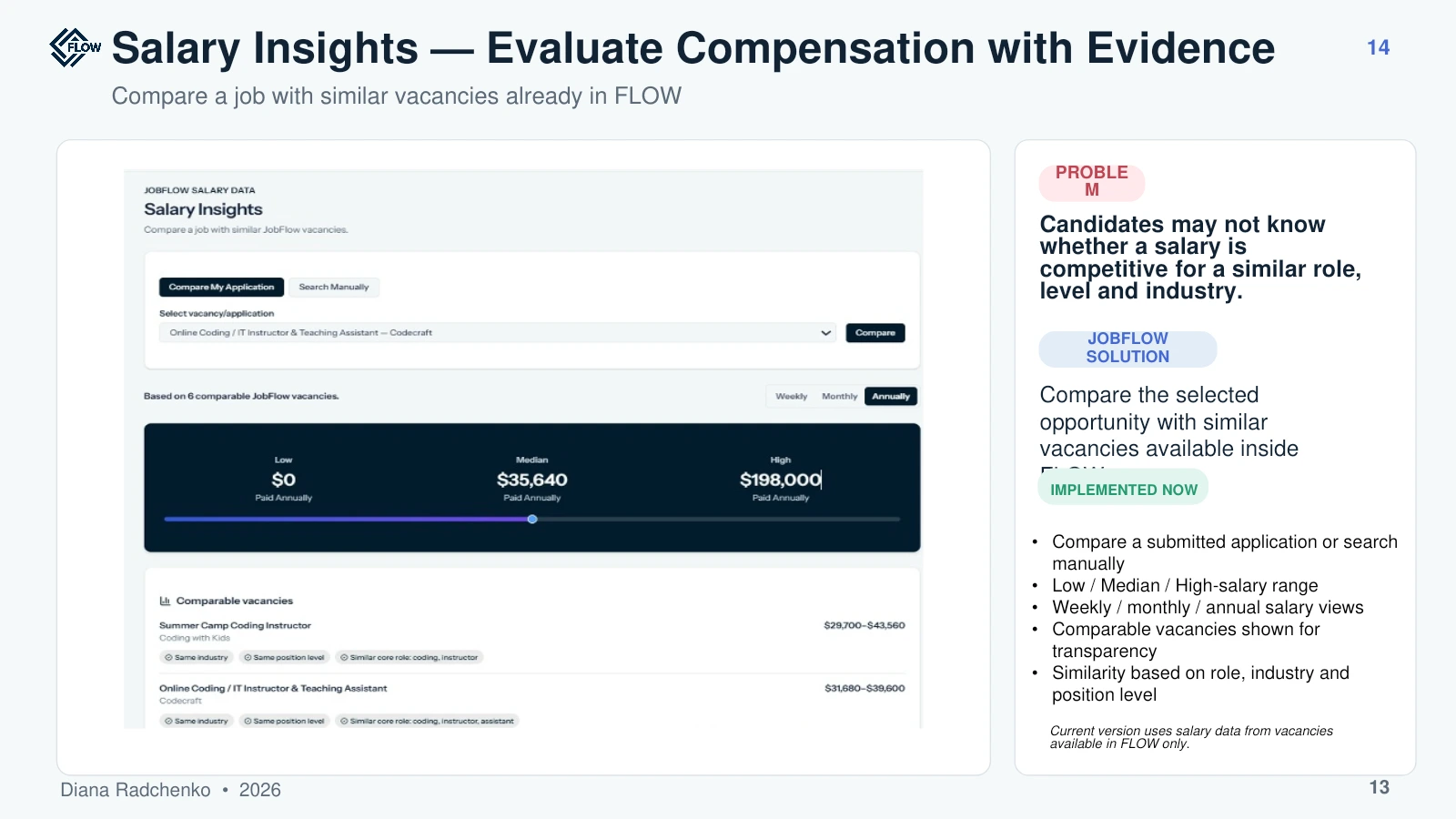
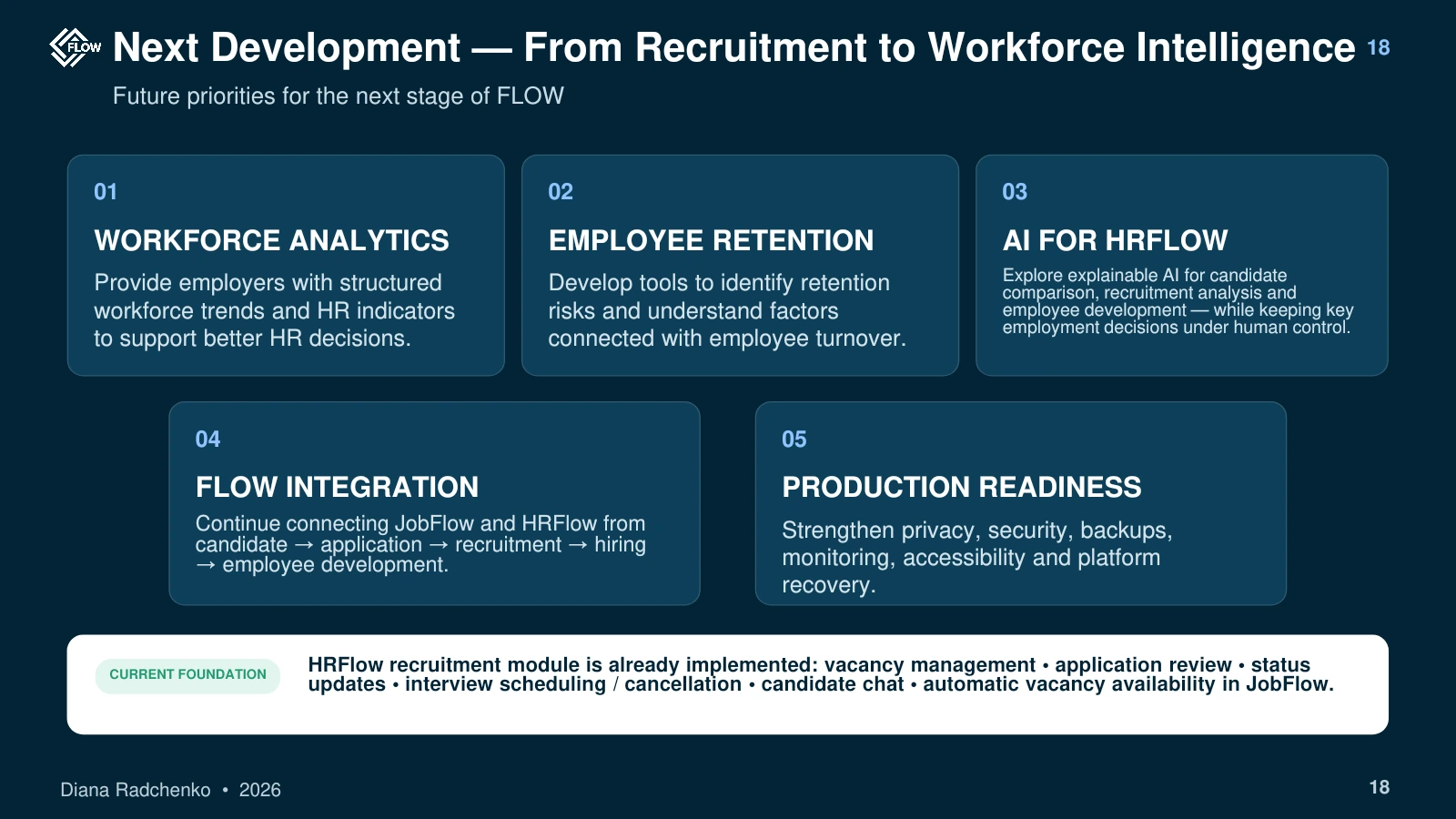
HRFlow currently handles recruitment. Onboarding, workforce analytics, retention, and broader employee development are future plans. Salary Comparison uses vacancies stored in FLOW; AI Resume Salary Analysis is a separate model-generated estimate.
Original presentation slides. Frames containing credentials or private account and conversation details are excluded.
Ethical Audit of Artificial Intelligence Algorithms
Problems and Challenges for Modern Legislation
Research question
How can ethical auditing become part of AI regulation?
Zenodo · DOI 10.5281/zenodo.21295535
The question behind the paper
How can fairness and transparency become practical requirements when algorithms affect people?
The approach
Compare regulatory approaches, examine published cases, and develop proposals for auditing and oversight.
My contribution
I read and compared international regulatory documents and digital-ethics concepts, and examined published cases and approaches to AI regulation. The paper identifies gaps between ethical principles and the mechanisms needed to put them into practice.
From this comparison, I drafted proposals for making ethical auditing a mandatory practice, incorporating ethical criteria into legal frameworks, and creating a certification system for AI algorithms.
The cases come from published sources. I did not conduct experiments or audit deployed systems.
The challenge addressed in the paper
From principle to requirement
Fairness and transparency are broad principles. An audit needs criteria that can be checked.
The paper examines how ethical criteria could be incorporated into legal frameworks and oversight practices. Its proposals are arguments developed through document analysis, rather than experimentally validated results.
Current scope
This portfolio summarizes the paper’s analysis and proposals; it is not a current legal guide.
Publication
Ethical Audit of Artificial Intelligence Algorithms: Problems and Challenges for Modern Legislation